The Committee said take it to the AG. Here is what happens when you do.
Last November, Nicole Burnard – a sitting member of the Sudbury School Committee – filed an Open Meeting Law complaint against her own chair. She alleged that Chair Karyn Jones had kept items off the committee’s agenda after the full committee voted 5-0 to bring them back: the school roof and Chapter 70 funding, with a Special Town Meeting deadline approaching. She attached the committee’s own policies, the MASC chair guidance, and all three meeting agendas. She built it carefully, in the form the Law is designed to receive.1
The Attorney General declined it. Not on a technicality – on the merits of what the Law covers. The Open Meeting Law, the AG held, “does not govern whether or when a public body must discuss a particular topic.” A chair acting beyond the body’s authority is an internal question, “not a matter governed by the Open Meeting Law.”2
That ruling is not a surprise. It is how the Law works.
What the Law is for, and the record. Every determination letter the Attorney General issues opens with the same 1978 citation: the Open Meeting Law exists “to eliminate much of the secrecy surrounding deliberations and decisions on which public policy is based.”3 Secrecy. Not unfairness. Not incompetence. Not whether the chair followed the body’s own rules. The Law watches whether the room was open, the notice was posted, and the minutes were kept. It does not judge what the body decided once the room was open.
A body that posts its minutes three months late can be found in violation. A body that ignores a 5-0 vote of its own members cannot.

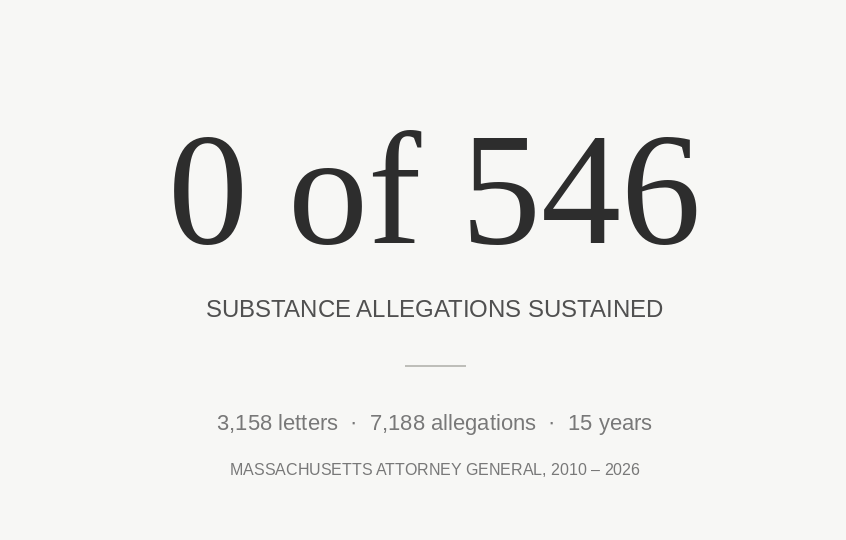
A review of the Attorney General’s complete record of determination and declination letters – 3,158 letters spanning 2010 through 2026, covering 7,188 individual allegations – shows a pattern that holds across every body type and every era.4
Process allegations – were the minutes approved on time, was the notice posted, was a roll call taken? – sustain about a third of the time: 34.0% before the pandemic, 32.1% during emergency remote meetings, 32.9% in the hybrid era. Flat across fifteen years.5
Substance allegations – asking the Law to judge whether a body discussed the right topic, made the right decision, or treated someone fairly – have been sustained zero times. Zero of 546.6
In school committees specifically, zero of 57 substance allegations have been sustained. Forty-nine of them – 86% – were thrown out as categorically not OML questions, never examined on the merits.7
Even when a body is found in violation, the consequence is almost always an order to comply going forward. The typical fine runs $200 to $500. The largest fine in the AG’s entire record is $2,000, imposed once.8 There has been one nullification of a vote – in Chicopee, where the votes “had not yet taken effect.”9 Lincoln-Sudbury’s Regional School Committee came within a certified-mail date of a $1,000 penalty in 2015 and escaped it on a mailing technicality.10
The Law checks whether the public could see the decision being made. It has never once ruled on the decision itself.
What the Sudbury complaints show. Since November 2025, seven OML complaints against the Sudbury School Committee have reached the Attorney General. Three have been decided – Burnard’s original, Sax, and Hayes – all declined on the merits of what the Law covers.13 Four remain pending: two from Burnard and two from Warzynski.11 The AG’s own regulation says complaints are resolved “generally [within] 90 days.”12
Hayes alleged the chair cut public comment short and discriminated by viewpoint. On October 27, 2026 – ten months after filing – the AG declined to review. “Even assuming the allegations raised in your complaint were true,” the declination reads, “they would not constitute a violation of the Open Meeting Law.”13 Public comment has been raised 201 times in the AG’s record and sustained zero times.14
Warzynski’s first complaint alleges the committee improperly used executive session Purpose (1) – which authorizes closed sessions to discuss “complaints brought against a public officer” – to discuss a citizen’s petition calling for a vote of no confidence. Purpose (1) for complaints against the body itself has been settled since 2011, across twelve determinations the committee’s counsel cited in its response.15 In school committees specifically, that doctrine is zero for ten. The single time it was sustained anywhere in the corpus, the body had discussed a complaint that was not even filed against its own members – the exception that marks the rule.16
Burnard’s second complaint shares many of the same traits; but it has one thing the decided complaints do not.
The complaint alleges that the chair coordinated with committee members through the committee’s counsel to drive decisions about the superintendent’s contract without a public meeting. The committee’s counsel responded that “one member, unsolicited, shared specific items with the Chair in late November that they wanted to add to an upcoming meeting agenda.”17
But the chair’s own email says something different. On November 29, 2025, Jones emailed counsel with the subject “How to handle agenda requests for Superintendent Performance.” In the email, she wrote that “a couple of Committee members have asked that I add a discussion item to an upcoming agenda regarding the Superintendent’s performance. They have shared several concerns they would like the Committee to discuss and address together,” followed by seven listed concerns.18

A couple of members plus the chair is three of five – a quorum. Counsel’s response says one.
The exception that counsel relies on – that a member may ask the chair to add a topic to the agenda without it constituting deliberation – states its own limit in the next sentence. The AG wrote in OML 2021-41 (Monterey) that “it is not permissible, however, for the public body member to follow up on that request with a statement about why it is important that the topic be addressed by the public body or to advocate support for a certain position with respect to that topic.”19 Seven listed concerns is not a bare request. And the body in Monterey was found in violation – Committee counsel cites an exception from a case the respondent lost.
The quorum matters too. In OML 2014-76 (Groton), a chair phoned members one by one to gauge support for a position – and the AG sustained it as serial deliberation reaching a quorum.20 The chair’s email describes the same pattern: multiple members communicating their positions to the chair through counsel, outside a public meeting.
The AG may determine this complaint differently than any prior case. But this is the one place in these complaints where the record the AG will review contains a discrepancy between the chair’s own words and counsel’s account of them, and the doctrine counsel invokes carries a limit the chair’s email may have crossed.21
What the Law does catch. The claims that win in the AG’s record are documentary and objective – things a reader can check against a posted record without knowing anyone’s intent.
Earlier this year the AG found the Worcester School Committee in violation because its meeting notices listed the executive session before the open session. The Law requires a body to convene in open session first, announce the executive session’s purpose, and vote by roll call to enter it – the public’s right is to witness that vote. A notice that lists the executive session first, the AG held, “gave the impression that there would be no open session prior to the executive session during which the public could witness the procedure to enter executive session.” The AG found the notice-order defect while upholding the committee’s use of Purpose (1) to review an OML complaint – the Purpose (1) use was proper, the paperwork was not.22
Sudbury School Committee notices follow the same structural pattern. The November 24, 2025 notice listed “6:30 Open Executive Session” before “7:00 Open Regular Session.” The January 5 and January 14, 2026 notices did the same. The February 5 notice went further: it listed no open session at all, announcing the committee would “meet in executive session and to NOT return to open session.”23
The May 18, 2026 notice – the meeting at which the committee reviewed the Warzynski complaint – originally carried both defects: the executive session listed first, and “to not return to open session.” The committee amended the notice the next day, striking the “to not return” language, but left the executive session listed at 6:45 p.m. before the open session at 7:00 p.m. – the exact defect Worcester lost on.23a

Nobody has filed on it. The notices are public.
“No violations” becomes “did not exist.” At the May 20, 2026 Special Town Meeting, Vice Chair Jessica McCready presented the committee’s case against the vote of no confidence. Her slides directed voters to the Attorney General for OML complaints and told them the result of the Committee’s own review: “NO VIOLATIONS found after review by the attorney.” The attorney was the Committee’s own outside counsel – not an independent finding. The slides were plain: “Cannot talk about contract negotiations in public… Not nefarious – it’s the law.”24

Four months later, former Selectman Len Simon turned that claim into something more. In his September 9 column, “Coincidence?”, Simon wrote: “On May 20 we learned from Town Counsel that all four of the alleged violations of law listed in the ‘no confidence’ petition, including multiple OML violations, did not exist.” He called the Town Meeting vote “a nullity, a miscarriage of justice.”25
The transcript says otherwise.
Simon himself set the conditions. At Town Meeting, he asked Town Counsel: “Has there been any finding… Not a claim, but a finding.”26 Town Counsel answered within those constraints – carefully, and with qualifications Simon’s column omitted:
- On conflict of interest: “I am not aware of any… most conflict of interest determinations are not necessarily resolved publicly.”27
- On the Open Meeting Law: “The database that the attorney general maintains… has no mention of the school committee going back to 2010.”28
- On procurement: “There’s none that I’m aware of, though again, we are not counsel to the school committee, so I can’t speak definitively.”29
- On executive session: “I’m not counsel for the school committee, so I won’t see everything. I can only see the information online that you can see.“30
“No finding in a database” became “did not exist.”
On May 20, two OML complaints against the School Committee were already waiting at the Attorney General – Hayes since December 29, 2025, and Burnard’s second complaint since April 7, 2026. Warzynski’s had been filed with the body eight days earlier.31 The AG’s determination database that Town Counsel cited lists only decided matters. Pending complaints cannot appear in it. Hayes has since been declined. Burnard’s second complaint and Warzynski’s remain pending.
A lawyer reporting the absence of a ruling, repeated four months later as proof of innocence – on a database that cannot show what was already there.32
Legal is the floor. At the same Town Meeting, the petitioner who presented Article 4 said it plainly: “Is it legal?” is the wrong question. “‘Legal’ is the floor, not the ceiling.”33
The Chair’s own email to counsel says the rest. Subject line: “How to handle agenda requests for Superintendent Performance.” Not whether to handle them. Not should we address these concerns. How to do it legally.34
Simon wrote in the same column: “Real accountability takes place at annual elections.”35
On that point, the Monitor agrees. The spring election is in March.
Notes
1 Burnard complaint, filed November 3, 2025 (OML form filed with the Town Clerk, with notice to the Chair). The complaint attached three SC meeting agendas and the MASC Guidelines for School Committee Chairs. Obtained via public records request. Full complaint (PDF). ↩
2 Burnard declination letter, Attorney General’s Division of Open Government, July 14, 2026. Quotes are exact. Declination letter (PDF). ↩
3 Ghiglione v. School Committee of Southbridge, 376 Mass. 70 (1978). The AG cites this as the legislative purpose in every determination letter. ↩
4 The dataset comprises every determination and declination letter in the Attorney General’s public record, 2010-2026: 3,158 letters, 7,188 allegations. A companion data article is forthcoming. ↩
5 Process sustain rates by era: pre-remote (2010-2019) 34.0%, emergency remote (2020-2021) 32.1%, hybrid (2022-2026) 32.9%. ↩
6 Substance allegations are those asking the AG to judge a body’s internal governance, policy choices, or treatment of individuals – as distinct from process (notice, minutes, procedure) which the Law was built to enforce. ↩
7 School committee substance: 0 of 57 sustained, 49 of 57 (86%) “out of scope”; categorically not OML questions per the AG’s own determination. ↩
8 The largest fine: $2,000 in Webster (OML 2017-23). Typical fines when imposed: $200-$500. See Ware OML 2026-28 ($300), Barre OML 2025-80, Shutesbury, Chicopee OML 2025-173 ($500), Wayland ZBA OML 2025-37 ($200). Only 41 of 266 intent/penalty allegations found intentional; even most of those drew no fine. ↩
9 Chicopee City Council OML 2023-24. The AG voided salary votes that “had not yet taken effect.” The AGO’s own metadata lists three nullifications, but only Chicopee was an actual order; Peru was ordered to repeat and ratify, and Dudley was a referral to a hearing. One nullification in fifteen years. ↩
10 Lincoln-Sudbury Regional School Committee OML 2015-94. The July 21 determination found multiple process violations and recommended a $1,000 civil penalty for intentional violation. On reconsideration (October 13), the AG reversed the intentional finding and erased the fine: a certified-mail receipt showed the prior-warning determination had arrived a day late, so the warning that proves intent did not count. ↩
11 AGO Division of Open Government pending complaints listing. As of October 28, 2026, four complaints against the Sudbury School Committee remain pending: two from Burnard (AGO complaint numbers 1329579 and 1335694, filed April and May 2026) and two from Warzynski (1337922 and 1338980, filed June and July 2026). This article discusses one Burnard and one Warzynski complaint in detail; the substance of the other two is not yet public. A separate pending complaint (Higgins v. Sudbury Select Board, filed August 12, 2026) is unrelated to the School Committee. ↩
12 940 CMR 29.05(8): complaints are resolved “generally [within] 90 days.” The regulation carries no enforcement mechanism for the timeline. Three or more registered voters may bypass the AG entirely and file directly in Superior Court under G.L. c. 30A, s. 23(f), with the same remedies (compliance orders, nullification, civil penalties). The respondent bears the burden of proving compliance. See Three Registered Voters v. Lynnfield Board of Selectmen, 90 Mass. App. Ct. 15 (2016). ↩
13 Hayes declination letter, Attorney General’s Division of Open Government, October 27, 2026. Filed December 29, 2025 – ten months before decision. Quote is exact. Declination letter (PDF). This is the third Sudbury School Committee declination since July 2026 (Burnard #1, July 14; Sax, July 23; Hayes, October 27). All four declined on the merits of what the Law covers. ↩
14 Public comment: 0 of 201 sustained (pre-Hayes; Hayes was declined without reaching the merits, so it does not enter the allegation count). Doctrine quotes from the AG’s standard language, repeated across hundreds of letters. The Law’s chair-discretion provision is G.L. c. 30A, s. 20(g). ↩
15 Committee counsel (VDH) response to the Warzynski complaint (May 18, 2026, p. 3), citing twelve determinations spanning fifteen years: the AG has stated “unequivocally” that a complaint against a body is “brought against a public officer” within the meaning of Purpose (1). Response (PDF). ↩
16 Whitman OML 2025-176 – the single sustain in the Purpose (1) body-complaint doctrine, and the complaint was not filed against the body that discussed it. ↩
17 VDH response to Burnard’s second complaint, March 6, 2026, p. 2, fn. 2. The actual member email is withheld as privileged. OML complaint and response (PDF), p. 2. ↩
18 Jones email to counsel, November 29, 2025, 8:26 AM. Subject: “How to handle agenda requests for Superintendent Performance.” Attached as an exhibit to the complaint as filed by the complainant, who posted it publicly. Jones email (PDF). ↩
19 OML 2021-41 (Monterey), citing OML 2014-76. The full passage continues: “See OML 2014-76” (Groton), where a chair phoning members one by one to gauge support was found to be serial deliberation reaching a quorum, sustained. ↩
20 OML 2014-76 (Groton). Sustained: chair canvassed individual members on a position, constituting deliberation reaching a quorum. ↩
21 Counsel’s response also cites “OML 2017-7” for the agenda-request exception. That determination number (Fairhaven) concerns where a notice was posted, not agenda requests. OML 2021-41 cites “OML 2016-7” (Tyringham) for the same rule. The number is likely a transposition. ↩
22 Worcester School Committee OML 2026-85 and OML 2026-86. In 2026-86, the AG upheld the committee’s use of Purpose (1) to review OML complaints while sustaining the notice-order violation. ↩
23 SC meeting notices: November 24, 2025; January 5, 2026; January 14, 2026; February 5, 2026. Agenda PDFs in the district’s public record. The February 5 notice maps onto Hubbardston OML 2017-161, where a notice listing only the executive session was found in violation. The February 9, 2026 notice uses the correct format – “7:00 p.m. Open Regular Session” first, executive session nested within – showing the committee’s staff is not unfamiliar with it. ↩
23a SC meeting notice, May 18, 2026 (amended agenda, originally posted 5/14/26, amended 5/15/26). The executive session block states “to not return to open session,” but the notice then lists a full open session agenda beginning at 7:00 p.m. This is the meeting at which the committee reviewed the Warzynski OML complaint under Purpose (1). ↩
24 McCready Article 4 presentation, Special Town Meeting, May 20, 2026. Slides obtained from the Town of Sudbury’s official Town Meeting record (MapsOnline presentations API). Slides (PDF). ↩
25 Len Simon, “Coincidence?”, Sudbury Weekly (Opinion), September 9, 2026. Emphasis added. ↩
26 Special Town Meeting, May 20, 2026 (SudburyTV recording, 03:24:19-03:24:38). ↩
27 Town Counsel, STM 5/20/2026, 03:24:41-03:24:53. ↩
28 Town Counsel, STM 5/20/2026, 03:25:48. ↩
29 Town Counsel, STM 5/20/2026, 03:26:18. Emphasis added. ↩
30 Town Counsel, STM 5/20/2026, 03:27:19. Emphasis added. ↩
31 Hayes filed December 29, 2025. Burnard #2 filed April 7, 2026. Warzynski filed with the body May 12, 2026 (received by the AG June 12, 2026, per the July pending list). ↩
32 Simon’s own OML record: in OML 2014-148, then-Selectman Simon was found in individual violation for five serial email deliberations – memos to a quorum of the Select Board on the Bruce Freeman Rail Trail, alcohol regulations, CPC funding, and a chain restaurant. He later filed OML 2024-223 against the current Select Board and the AG found no violation. He has been on both sides of the gap between a finding and the facts. ↩
33 Article 4 presentation, Special Town Meeting, May 20, 2026. Slides obtained from the Town of Sudbury’s official Town Meeting record. Slides (PDF). ↩
34 Jones email to counsel, November 29, 2025. The full subject line is “How to handle agenda requests for Superintendent Performance.” The email body is a complaint exhibit posted publicly by the complainant. See fn 18 for the hosted document. ↩
35 Simon, “Coincidence?”, Sudbury Weekly, September 9, 2026. ↩