In the middle of a contentious Sudbury School Committee election, resident Colleen Gleason submitted a targeted public-records request seeking emails from the wife of a write-in candidate.
The request came against a broader backdrop of mistrust surrounding the Committee. In recent months, residents have criticized the Committee over alleged Open Meeting Law violations, the handling of Superintendent Brad Crozier’s departure, and an RFP process that many families feared could displace Sudbury Extended Day, the town’s longtime after-school provider. Public meetings drew unusually strong community response, while the Committee offered limited public explanation for several disputed decisions.
The newly released records do not prove misconduct. But they do raise uncomfortable questions about the relationship between School Committee Chair Karyn Jones and politically aligned residents involved in the Committee debate.
According to the records, Gleason requested emails sent by Jennifer and Jonathan Sullivan after Jonathan Sullivan launched a write-in campaign for School Committee. Sullivan’s campaign was associated with support for Crozier and Sudbury Extended Day, both major flashpoints in the town debate.
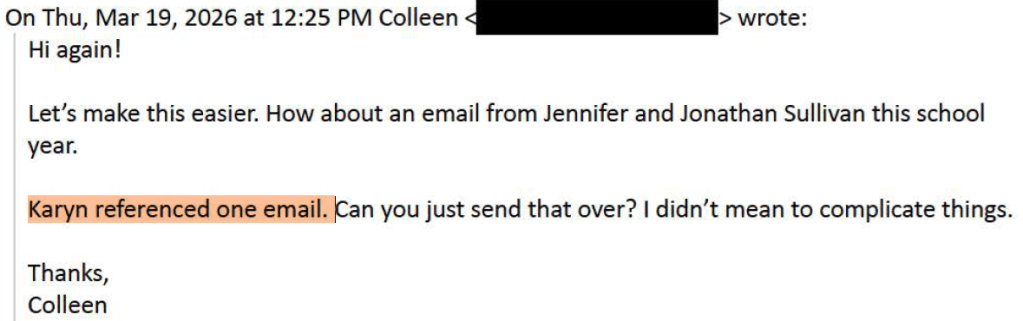
The district eventually identified a single responsive email opposing the proposed LGBTQ+ Parent Advisory Committee. One line in the correspondence stands out. In a follow-up email to district officials, Gleason wrote: “Karyn referenced one email. Can you just send that over? I didn’t mean to complicate things.”
That statement suggests Jones had separately informed Gleason that a responsive email existed before the district formally fulfilled the request.
The timing made the request especially sensitive. Gleason submitted it on March 15, a little more than two weeks before the March 31 election. The district produced the responsive record on March 30 – the day before voters went to the polls. Gleason does not appear to have posted the email herself; instead, it was circulated by another resident active in the same campaign debate.
The records do not show whether that timing was deliberate. But in the context of a write-in campaign, a politically charged school debate, and a records request focused on the candidate’s family, the sequence is difficult to dismiss as routine.
Jones later personally pressed administrators to complete the request within statutory timelines. In a March 25 email to district officials, Jones wrote that Gleason had made her request on March 15 and asked them to confirm “what day she will receive this to meet the statutory requirements.”
None of this conclusively establishes improper coordination. Public officials routinely interact with residents, and public-records requests are a legitimate part of civic engagement. But the appearance is difficult to ignore: the Chair of the School Committee became directly involved in advancing a politically sensitive records request concerning the family of a candidate aligned with critics of the Committee.
At a moment when Sudbury residents are preparing to debate a vote of no confidence in School Committee leadership, these records are likely to deepen concerns about transparency, impartiality, and political judgment at the highest levels of district governance.
For residents already concerned about public accountability, the emails may reinforce the perception that too much of the Committee’s work has been happening out of public view.
 The Sudbury Monitor
Leave a comment