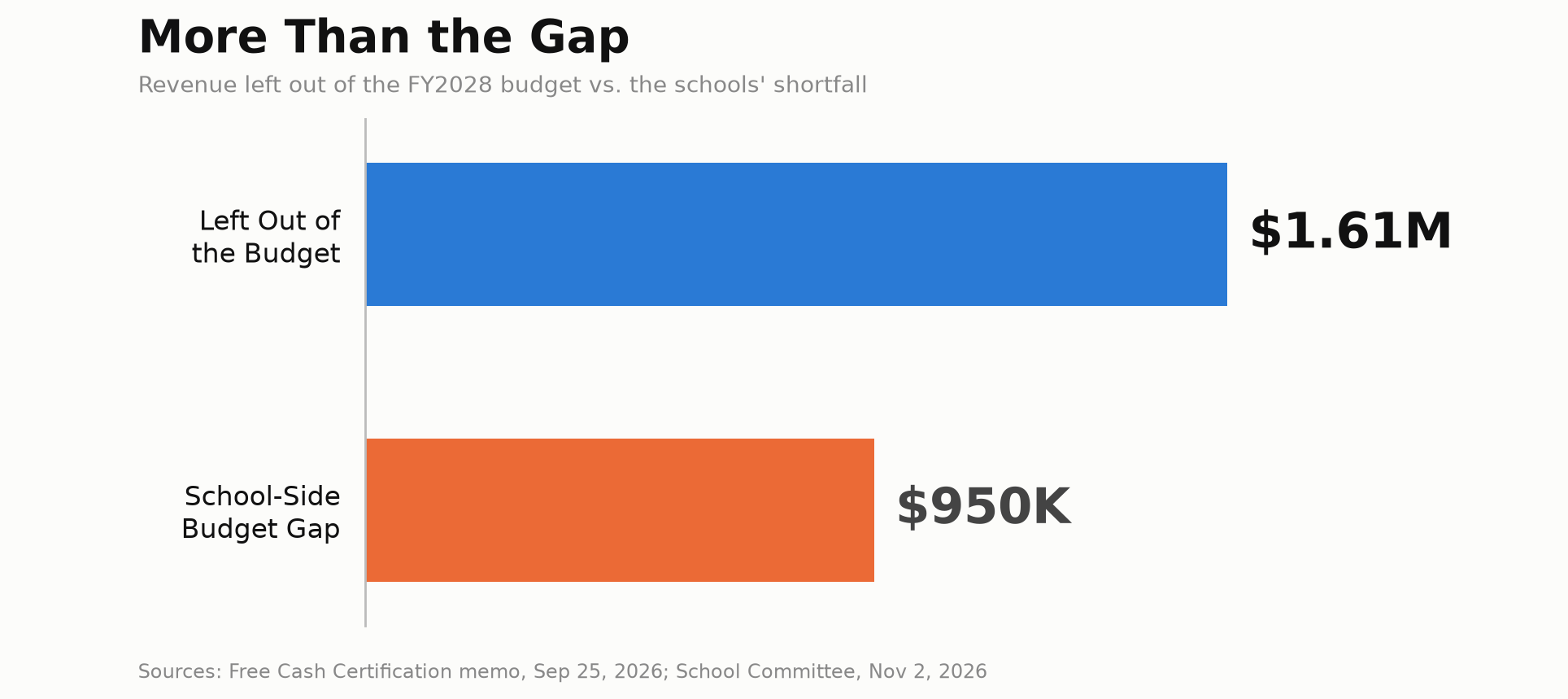
The Finance Director’s own analysis identifies $1.61 million the Town collected last year and is leaving out of next year’s budget.
Sudbury may ask residents to approve an override next spring – a permanent increase to the property-tax levy limit – to close a budget gap. The school-side gap is $950,000.[1] But the Town’s own Finance Director, in a September memo to the Select Board and Finance Committee, identified $1.61 million in revenue the Town collected last year but has left out of next year’s budget.[2] That is more than the gap.
Money the Town collects but doesn’t budget isn’t lost. “Free cash” is money left from prior years that the state certifies as available to spend. Most of what was added last year was revenue that came in above budget.[3] Town Meeting can spend it on capital projects or put it into reserves. But budgeting the $1.61 million as revenue would make it available for the yearly operating budget instead.
The disappearing deficit. The FY2028 Budget Working Group, the town and school officials who assemble the budget each fall, cut the projected deficit for the schools, Lincoln-Sudbury and town departments combined from $3 million in June to $289,158 by October.[4] On October 7, Town Manager Andy Sheehan told the group the June deficit “has come down since then to under $300,000”. Most of the improvement came from the revenue side: $660,000 from raising revenue estimates, and $1 million drawn from savings – free cash, and a stabilization fund Town Meeting tops up from free cash.[5]
At the September 14 Finance Committee meeting, Finance Director Victor Garofalo described where the Town is headed: “We might be able to… navigate fiscal year 28, but eventually we’re going to need that override” (1:09:03).
Then the Town set its guidance, the increase it tells each department to plan for. The October forecast had assumed 4.5 percent for the Sudbury Public Schools. On November 2 the guidance arrived at 3.6 percent, the level at which the Town’s forecast balances, with a $37,020 surplus.[6] The Superintendent’s preliminary budget needs 5.53 percent. The difference is about $950,000.[7]

What the Town actually collected. In FY2026, the budget year that ended June 30, the Town collected $4.53 million more than it budgeted. Real estate taxes, its largest revenue source by far, came in slightly under budget. State aid came in on budget. Most of the excess is in local receipts: what the Town collects besides property taxes and state aid, such as car excise tax, permit fees and interest on its cash. The Finance Director’s September 25 memo has the full breakdown.[8]
| Revenue Source | Budgeted | Collected | Difference |
|---|---|---|---|
| Real Estate & Personal Property | $112,699,454 | $112,086,149 | ($613,305) |
| Intergovernmental (State Aid) | $8,089,560 | $8,071,734 | ($17,826) |
| Motor Vehicle Excise Tax | $3,858,000 | $5,293,015 | +$1,435,015 |
| Penalties and Interest | $250,000 | $854,117 | +$604,117 |
| Licenses and Permits | $801,000 | $1,170,057 | +$369,057 |
| Earnings on Investments | $255,334 | $1,833,567 | +$1,578,233 |
| TOTAL REVENUES | $127,063,599 | $131,594,231 | +$4,530,632 |
Selected lines. The total covers all revenue.
A conservative estimate comes in a few percent under. The Town budgeted $255,334 for a line that produced $1,833,567: 14 percent of what came in.
Garofalo set aside the part of the $4.53 million that won’t repeat ($1.31 million from long-overdue and deferred property-tax accounts, settled in a single year) and the $865,000 of growth already written into this year’s budget. What remained was $2.36 million in revenue capacity. For FY2028 he proposed budgeting $750,000 of it. That increase is already in the Town’s forecast. The other $1.61 million stays out of the budget.[9] Most of it, about $1.08 million, is interest on the Town’s cash.
The Town earns that interest on the cash it holds. After the Federal Reserve began raising rates in 2022, the income went from a small loss in FY2022 to $1.97 million in FY2025 and $1.83 million in FY2026. The Town budgeted $105,000 for FY2025 and $255,000 for FY2026. For FY2027 it budgeted $400,000.[10]

Not one year. Interest is only one line. The Finance Director’s own Financial Report and Reference Guide, updated in June 2026, shows total local receipts – excise, permits, fees and interest together – above budget in every year from FY2018 through FY2025.[11] That includes the years before interest rates rose. In FY2025 the Town budgeted $5.68 million and collected $9.74 million.[12] In FY2026 it budgeted $6.27 million and collected $10.67 million – 70 percent more.[13]
Conservative revenue estimates are standard. The state’s Division of Local Services describes prudent practice as “purposefully underestimating revenue projections by at least a few percentage points.”[14] In its October 2025 Financial Management Review of Sudbury, the same office observed that the town has “recently realized some year-to-year increases in certified free cash, largely thanks to revenues that outperformed the town’s conservative estimates.”[15]
“Less excess revenue.” Garofalo has said why the estimates stay low. At the September 14 Finance Committee meeting: “I caution you in increasing the local receipts any further. As we increase our local receipts, that means that we’re going to revert less money to free cash” (0:45:20). Then: “It just means there’s going to be less excess revenue” (0:45:32). Free cash pays for capital projects; budgeting closer to actuals leaves less of it. The Finance Director’s September memo puts certified free cash at $9,985,147, about $3.4 million above the top of the Town’s policy target range.[16]
On October 7 he told the Working Group the Town could go further, and would not: “While there’s also, you know, additional revenue that we could tap, we don’t want to go to 100% revenues, because we just don’t know what the feds are going to do with interest rates” (0:05:26). At the June 18 Working Group he explained that the interest also depends on how much cash the Town keeps: “It’s the balances in our account. So as we use more free cash, or we use more of our revenue, that just means less money in the town’s bank account to invest” (0:27:36).
“That was their gap.” At the Finance Committee and the Working Group, the conversation is about revenue: how much to budget, how much free cash to expect. In the school meetings, it is about costs.
At the School Committee’s Budget Subcommittee on October 23, Acting Business Director Buck Creel walked through what the teacher contracts, almost 60 percent of the school budget, will cost next year. During the discussion, one participant said: “I was surprised at how much the gap has closed.” The answer: “Yeah, but that was their [the Working Group’s] gap” (1:22:00).
The $1.61 million was not mentioned in the 117-minute meeting.
The projected deficit is not a discovery. It is a product of how the Town chooses to count money it already collects.
If residents are asked to approve an override that permanently raises their property-tax levy limit, they should see the revenue side of the equation first – including the $1.61 million the Town already collects and does not count.[17]
Sources
- Buck Creel, Acting Business Director, report to the Sudbury School Committee, Nov. 2, 2026: guidance of 3.6 percent is “about $950,000 less than we had at a 5.53 percent budget.” SudburyTV, 3:04:10. ↩
- Victor Garofalo, Assistant Town Manager/Finance Director, memorandum to the Select Board, Finance Committee, SPS and L-S School Committees and FY2028 Budget Working Group, “Free Cash Certification,” Sept. 25, 2026, p. 7: “For FY2028 planning purposes, we are increasing recurring revenue estimates by $750,000. If adopted, approximately $1.61 million of favorable revenue capacity would remain.” ↩
- Free Cash Certification memo, p. 2: use of certified free cash at the 2026 Annual Town Meeting, “Stabilization and Capital Stabilization Fund, $575,000”; excess revenues of $4,530,632 were the largest of the $7,628,649 in FY2026 additions to free cash. ↩
- Andrew Sheehan, Town Manager, “Financial Condition & Forecast,” in the Select Board packet for Nov. 10, 2026 (Monitor copy of the presentation), slide 13 (“$3.00M starting deficit – June 2026”) and slide 16 (FY2028 deficit of $289,158 as presented to the Working Group on Oct. 7, 2026, with SPS, Lincoln-Sudbury and town departments in one model). ↩
- “Closing the $3 Million Budget Gap,” Town Manager’s Financial Condition & Forecast, slide 13: revenues and transfers +$2.19M (local receipts +$660K; free cash for OPEB +$500K; Capital Stabilization Fund for the Town Manager’s capital article +$500K; state aid +$284K; real estate tax for debt-excluded roof projects +$149K; ambulance receipts +$100K); net expense change -$517K (“Updated GIC enrollments; Middlesex County Retirement Assessment”); remaining gap ~$290K. The slide measures the increase from the June forecast ($660K); measured from the FY2027 budget it is $750,000 ($7,140,000 to $7,890,000, slide 15), the increase proposed in the Free Cash Certification memo. On free cash going into the stabilization funds, see the Free Cash Certification memo, p. 2. ↩
- “Revenue & Expenditure Forecast (updated FY28 Guidance),” Town Manager’s Financial Condition & Forecast, slide 19: “FY2028 assumes 3.6% operating increases for SPS, LS and Town departments”; FY2028 surplus $37,020. The Oct. 7 projection carried Sudbury Public Schools at $51,457,242, a 4.5 percent increase (slide 16). ↩
- Sudbury School Committee, Nov. 2, 2026, SudburyTV: Creel, “We received an email today from the town administrator and the finance directors giving us our FY28 guidance, which is not 5.53 percent. It was 3.6 percent” (3:03:54), and “about $950,000 less” (3:04:10). ↩
- Free Cash Certification memo, “FY2026 General Fund Revenue Performance,” pp. 4-5. The table here shows selected lines. ↩
- Free Cash Certification memo, pp. 4-7. Total revenues $131,594,231 against a budget of $127,063,599 (pp. 4-5); one-time tax title and deferred tax collections $1,306,199 (p. 5); revenue capacity table: $4,530,632 excess, less $1,306,199 one-time and $865,425 already added in FY2027, leaves $2,359,008; less $750,000 proposed for FY2028, leaves $1,609,008 (pp. 6-7). Of the $1,609,008 remaining, Earnings on Investments accounts for $1,083,557 (p. 7). ↩
- Investment income: FY2022 $(4,889), FY2025 $1,965,888 actual, FY2026 budget $255,334, FY2027 budget $400,000 – Town of Sudbury, Financial Report & Reference Guide, FY2018-FY2027 (June 12, 2026), p. 30; FY2025 budget $105,000 – Financial Report FY2017-FY2026, p. 30; FY2026 actual $1,833,567 – Free Cash Certification memo, p. 5. ↩
- Financial Report FY2018-FY2027, p. 32, “Sudbury’s Local Receipts Actual vs. Budgeted,” FY2018-FY2025. The April 2025 edition, p. 32, shows the same for FY2017-FY2024. See also Jean Nam, “Underestimates in Revenue Lead to a Windfall in Free Cash,” Sudbury Independent, Sept. 24, 2026, which makes the same argument from state Division of Local Services data. ↩
- FY2025 actual local receipts $9,741,536: Financial Report FY2018-FY2027, p. 30. FY2025 budgeted local receipts $5,678,251: Financial Report FY2017-FY2026, p. 30. ↩
- FY2026 budgeted local receipts $6,274,585: Financial Report FY2018-FY2027, p. 30. FY2026 actual local receipts $10,667,519: Town Manager’s Financial Condition & Forecast, “Revenue Projections (a/o 10/7/2026),” slide 15. ↩
- Massachusetts Department of Revenue, Division of Local Services, Financial Management Resource Bureau, Town of Sudbury Financial Management Review, October 2025, p. 10, “Goals Related to Free Cash” (archived copy). ↩
- DLS Financial Management Review, p. 6 (archived copy). ↩
- Free Cash Certification memo, p. 7: “The Town’s Financial Policies establish a target of maintaining a Free Cash balance equal to 3% to 5% of the annual operating budget. Based on the Town’s current budget, this target equates to approximately $6.5 million. The FY2027 certified Free Cash balance of $9,985,147 is therefore approximately $3.4 million above the upper end of the policy target range.” ↩
- An override under Proposition 2-1/2 permanently increases the property-tax levy limit (M.G.L. c. 59, § 21C(g)). Budgeting existing revenue more accurately does not change the levy limit. ↩