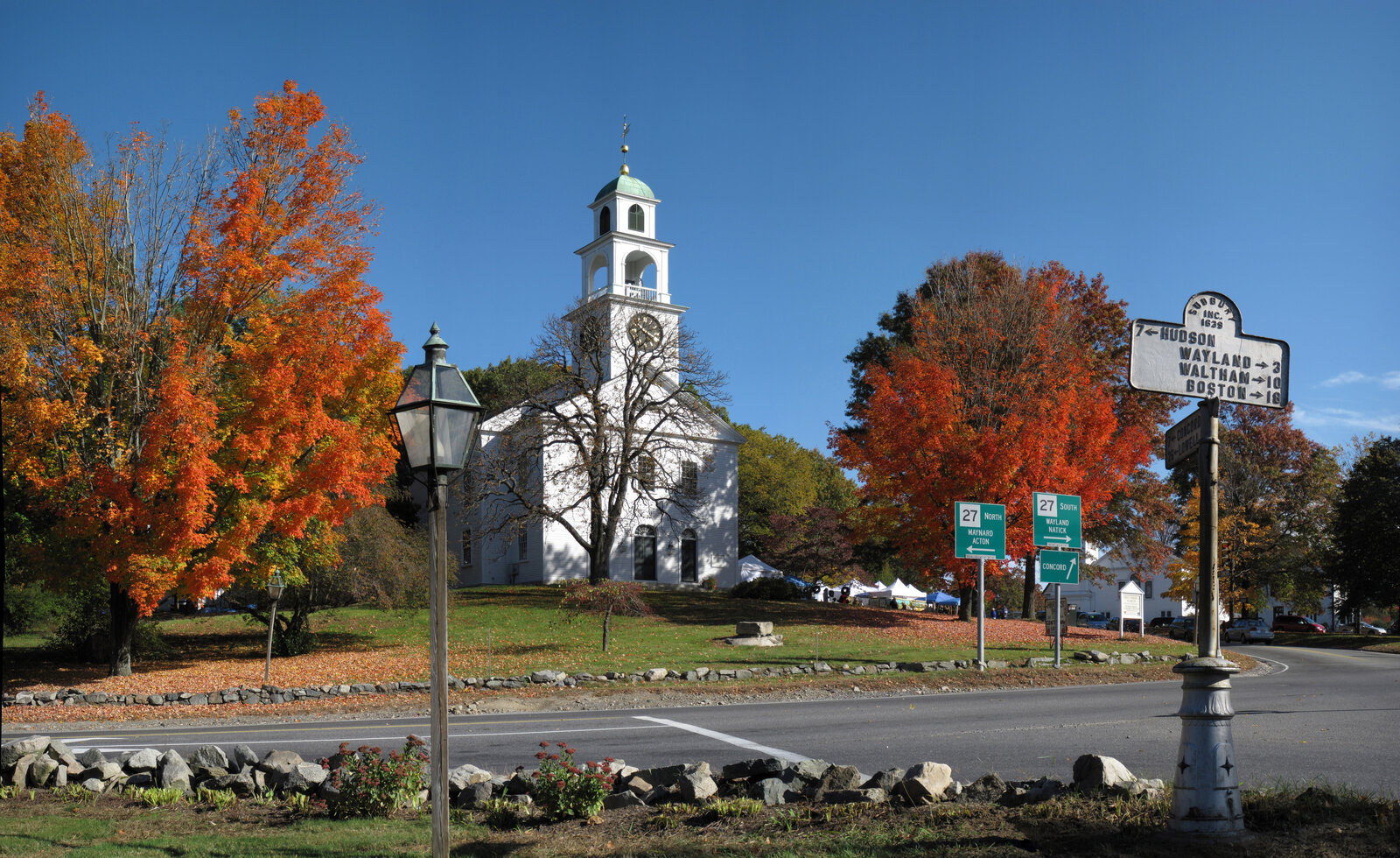
First Parish Meetinghouse, Sudbury Center, by Jan C. Hardenbergh, CC BY-SA 3.0, via Wikimedia Commons.
The Sudbury Monitor
Every town used to have a square: a place you went to learn what your neighbors were arguing about, and to argue back. Sudbury’s green has belonged to the First Parish since the seventeen-hundreds, and a single meetinghouse on it once held Sunday worship, Town Meeting, and the 1775 muster that marched toward Concord.
The green still hosts the ceremonies. It stopped hosting the argument a while ago. That moved online, to a Facebook group called “OneSudbury”, which is now where the town thinks out loud. It runs to about 5,100 members, and in a single scroll it carries a leaf-blower crusade, a duplex fight, the School Committee wars, and even a debate over the price of groceries.
What keeps a forum like that from curdling into the usual online muck is one rule: to post, you use your real name. The group was made private for exactly that purpose, to shut out the anonymous accounts that had turned other local boards to noise. The real-name rule is the whole engine. It is harder to smear a neighbor, or to invent a fact, when your name is fixed to the words and you might run into the person at the transfer station on Saturday.
No one pre-screens the posts; the group polices itself by complaint, with a handful of unpaid volunteer administrators as a backstop. The town’s civic life now runs straight through the group they keep the peace in.
The rule cuts both ways, and the moderators apply it evenly. It keeps out anonymous trolls; it also keeps out the Monitor, which carries no byline, so its posts come down even when a moderator, in their words, “agree[s] with most or all of the items” in them. The Sudbury Weekly, a local blog that residents often circulate through the feed as news, stays up, because it carries a name. The moderators are not in the business of fact-checking; the only line the rule draws is the byline, and they draw it against their own sympathies. That is about what principle costs.
The Sudbury Town Crier that once did this work is a shell of itself, so the feed has become, by default, the closest thing the town has to a public meeting that never adjourns. And it is not idle talk. In a single six-month stretch the arguments worked out here helped drive a no-confidence vote in the School Committee, a recall bylaw the town had never had before, and a write-in campaign that came within a few votes of a seat. Read six months of it and the tenor of the place comes down to a single chart.

One topic towers over the rest: the conduct of the School Committee. It is also the only fight in town with two real sides. Almost everything else, the budget, town-meeting access, the Sudbury Weekly, housing density, and the proposed leaf-blower ban, lands lopsidedly on one side. Sudbury is not a town at war with itself. It is a town that mostly agrees, loudly, and disagrees hard about one thing.
Most of that arguing is done by a small, dedicated group. About two dozen people write half of all the comments, and more than a third of everyone who posts does so just once. But the heavy posters are not a clique with a single grievance: they are the same people who turn up on everything, the budget one week and the geese the next, while the one-time posters tend to surface for the single thing that pulled them in. It is a committed civic core wrapped in a wide and casual public, which is roughly what a town square is supposed to look like. What the chart cannot show is how those voices argue. For that you have to read the words.
The one real fight

By a wide margin, the School Committee drew the most comment of anything in town, more than twice the next topic, and it was the only fight with two real sides. Among residents who took one, its critics outnumbered its defenders by more than three to one. That is lopsided, but it is not a fringe, and the critics are not one faction: former School Committee members and self-described progressives posted alongside fiscal conservatives. What they shared was not politics but a question. The committee had let a well-reviewed superintendent go without a public vote or a public reason, and the threads fill with residents asking why. The two sides did not only disagree about the answer; they argued from different ideas of what makes a decision legitimate, in the two vocabularies you can read straight off the chart.
To the critics, legitimacy comes from process: transparency, accountability, the contract, the minutes. Their asks are specific. “We should all be pushing for information,” one resident wrote. Another, again and again: request the executive-session minutes, or the committee is “violating [open meeting law] again.” A parent: a “small group of individuals can push an excellent leader out without any community explanation or discussion.” The recurring word is not corruption. It is transparency. The most common answer they got was that the committee could not say more, because the matter had been handled in executive session under attorney-client privilege. To the critics that was not an answer to the question; it was the question. A body that settles a contract behind closed doors and then points to the closed doors as the reason it cannot explain has, in their telling, used the law to manage the public rather than inform it.
The defenders answered in the other language, the words of conduct and motive: the critics are anonymous, or cruel, or attacking good people, their objections symbolic. Their move was to change the subject from the decision to the people questioning it. The complaint was no longer about a closed meeting; it was a culture war in disguise. Critic posts were “filled with so much conservative propaganda”; the petition was relabeled “Parental Rights,” recasting a transparency complaint as a culture-war cause it was not; a rally urged every voter who honors “the principles of diversity, equity and inclusion” to turn out against it.
You do not have to take a reading of a private Facebook group on faith. When the same fight reached the Special Town Meeting floor in May, both sides reduced it to a slide. The no-confidence petitioners opened with one line, “‘Legal’ is the floor, not the ceiling,” and built the rest on the words of the record: accountability, transparency, a timeline of who met whom and when, and nearly four hundred residents who “signed their names.” Presenting the committee’s case against the article, Vice Chair Jessica McCready answered in the other language: there had been “no violations found,” a complaint was not a violation, and a Special Town Meeting was “not an adjudicating body” in any case. “Cannot talk about contract negotiations in public,” her slides said. “Not nefarious. It’s the law.” Two decks, prepared separately for an audience of nine hundred voters, carried the same two languages the feed had been arguing in for months, now entered into the town’s own record.
From the feed to the floor
The argument did not stay online. It caught in March, after a report that the School Committee wanted to remove the superintendent, and for the better part of ten weeks it did not cool, running straight through the spring election, the superintendent’s exit, and the May Town Meeting.

And it did more than talk. The accountability side tried the ballot first: at the spring election a write-in candidate for the School Committee fell just short of a seat. Within weeks the argument turned structural. Residents began pushing a recall bylaw the town had never had, a campaign built partly in the feed and partly offline, with signatures gathered in person at a local Dunkin’. At a packed Special Town Meeting in May, both the recall and a separate no-confidence measure passed.
On its face the recall was content-neutral, a provision to remove any elected official, and it was written that way. But a recall bylaw is itself an accountability tool, and the case for one tracked the record: the town’s existing levers for accountability do not bite. The Attorney General had not ruled on the open-meeting complaints, a no-confidence vote is symbolic, the Select Board cannot be compelled by Town Meeting. Article 3 was the structural answer to that gap, and its sponsors made the case in those terms, calling the recall a “last resort accountability mechanism” and arguing that accountability delayed is accountability denied. The data shows who took them up on it.

Among residents who took a side on both questions, every one of the committee’s critics backed the recall, and every one of its defenders lined up against it. The recall split the town along the same line as the fight that produced it. That is less a disguise than a continuation: the residents who had spent months arguing the town’s officials were not answerable were the ones who wanted a way to make them answer. The floor fight that followed was a real one, but it was about how to build the tool, not whether to allow it, how high to set the ten-percent signature threshold, how long the ninety-day window, whether to bar a recalled official from re-appointment for two years. Those questions did not split cleanly by camp. The League of Women Voters moved to strike the bylaw’s simultaneous successor election, and a separate amendment to raise the threshold to twenty percent was offered as a way to strengthen the recall, not to block it, noting that every neighboring town with a recall sets its bar at fifteen or twenty percent. The committee’s defenders pressed the same procedural points harder, and the accountability side, which had spent months demanding process, waved some of them off as a “scare tactic” and a “red herring.” It is tempting to read that as a role reversal, but it is not quite one. Insisting an official answer for a decision and arguing over the parameters of a bylaw are different claims, and the accountability side’s through-line ran straight through both.
The organizing did not stop at the Town Meeting floor. The recall is a home-rule petition, so it still needs the state legislature to act, and the feed turned into a letter-writing campaign: a resident posted the bill number, the email addresses of the two legislators who would have to carry it, and a ready-made draft, “Not sure what to say? Try something like this.” Within the hour, neighbors were replying that they had sent it, and one that she would be calling both offices in the morning. The same reflex runs whenever the town is trying to move something, a hearing to show up to or an official to write to: the civic core’s other job is not just arguing, but handing a neighbor the address and the script.
They argue back
Read this far and the square can look like a cynical place: two camps, two vocabularies. The threads themselves are the rebuttal. A forum this lopsided is supposed to be an echo chamber, the majority talking to itself while the minority is ignored or driven off. OneSudbury is the opposite. The two sides are not in separate rooms: sort the whole tangle of who-replies-to-whom and it organizes by topic, not by camp, with critics and defenders mixed all through it. The outnumbered defenders are not shunned. They are the most answered people in the group, argued with thread after thread.

What comes back is mostly an argument. We read a sample of the replies that cross between the camps: most were points and counterpoints, about one in seven turned sharp, and the sharpness ran both ways. It is not a mob. It is a debate, under real names.
But the feed is not the town
It is tempting to read a lopsided feed as a lopsided town. It is not.

Among the residents who actually posted about the committee, almost nine in ten were critics. But a forum is not a ballot, and when the votes were counted the margins closed: the recall and the no-confidence measure carried by 54 and 60%, respectively; and the one race that put the fight straight to the voters, a write-in for the School Committee seat, lost by fifteen. For a write-in that is a remarkable near-miss. But the direction is unmistakable: the wider the room, the closer the count.
The more remarkable thing is what the feed does with that gap. It does not just vent; it organizes, and it moves people to stand up and act. Of the three measures it drove to a vote it went two for three: the recall and the no-confidence article passed, the write-in fell short. The feed moves the town to act, but it is not the ballot box. Which is the best reason there is for the residents it underrepresents to turn out and argue too.
The rest of the square
For all the heat in the School Committee fight, it is not what most of OneSudbury is about. Strip out the controversies and the feed is mostly the ordinary business of a town: the wells, the roads, the parks, the budget. Over a few days this spring one resident posted, and reposted, a case for banning gas-powered leaf blowers. The threads ran past a hundred comments, and the town came down against a ban about two to one. A senior on a fixed income asked who would replace his equipment; a work-from-home parent described the sound as all day, every day; someone planted a flag for freedom and signed off “#comeandtakeit.” No ban is coming, and it was never really about the ban. It is a hundred neighbors arguing about noise and money and what kind of town this is.
What it is for
Nobody would call it orderly. The square is lopsided, contentious, kept up by tired volunteers, and no stand-in for the ballot box. It is also the most honest picture the town has of itself, because it signs its name to everything. Set it beside the alternative. Last spring the School Committee issued a letter titled “Supporting Transparency” that defended a decision on legal grounds without ever saying what had been decided, or by whom. The feed, on its worst day, is more candid than that.
Messy, direct, participatory democracy is the legitimate source of a town’s authority. In Sudbury, it often lives in a comment thread, argued in two languages, under thousands of real names. You can read exactly where the town agrees, where it splits, and in whose words. It is worth showing up for.
Sources
The Monitor’s reading of OneSudbury. The topic counts, the lean, participation, timeline, recall and venue charts, the reply-tone sample, and every quotation attributed to an OneSudbury member are drawn from the Monitor’s own reading of public posts and comments in the OneSudbury Facebook group, January through June 2026. Residents who post under their real names are not named here.
Sudbury Monitor:
- Analysis: No Vote, No Answer – the superintendent’s removal without a public vote, the Open Meeting Law complaint, and the “Supporting Transparency” letter.
- Opinion: Sudbury’s Special Town Meeting Was Democracy, Not Dysfunction – the May 20 Special Town Meeting.
- 633 Pieces of “News,” Zero Opinions: Inside the Sudbury Weekly – the Sudbury Weekly’s School Committee coverage.
Town of Sudbury (official record):
- Special Town Meeting results, May 20, 2026 – Article 3 (recall) 474-394; Article 4 (no confidence) 452-295. The per-article record and the floor presentations, including the two Article 4 decks quoted above, are on the Town’s warrant-articles page (select STM-2026-May).
- 2026 Special Town Meeting warrant – the recall and no-confidence articles as written.
- Annual Town Election, March 31, 2026 – the School Committee write-in result, published by the Town Clerk (see the Town of Sudbury website).
Public documents:
- “Supporting Transparency,” School Committee communication – the letter quoted in the closing.
- “Vote of No Confidence in the Sudbury School Committee” petition – now at 576 signatures.