The Sudbury Monitor
The short version:
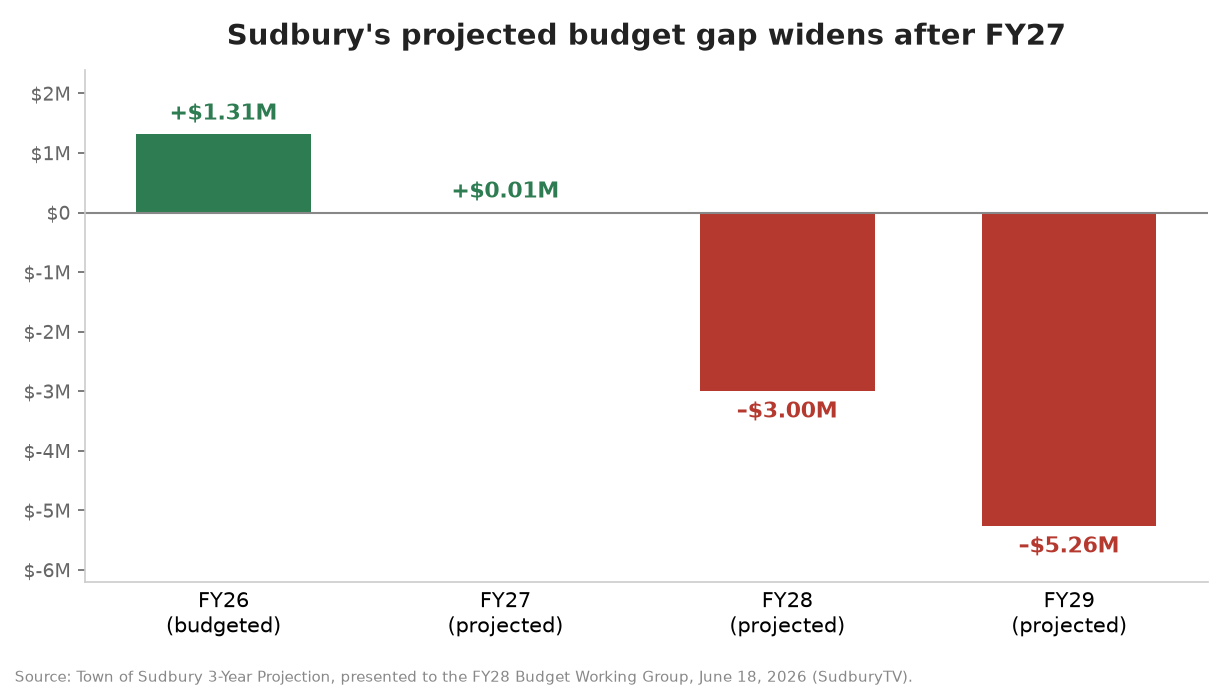
- By the town’s own numbers, Sudbury’s operating budget swings from balanced in FY2027 to a roughly $3 million gap in FY2028, and to about $5.3 million in FY2029.
- A new FY2028 Budget Working Group, convened by Town Manager Andy Sheehan, met for the first time on June 18 to start planning more than a year early.
- An override is openly on the table as the main way to close the gap, though officials stressed it is “not the default strategy.”
- The squeeze is structural: revenue is capped by Proposition 2½ while fixed costs – pensions, health insurance, contracts – rise faster, and the one-time windfalls that balanced recent years are running out.

On a rainy Thursday night, a dozen of the town’s budget decision-makers sat down around a table at the police station for the first meeting of a new FY2028 Budget Working Group. The group is unusual mostly for its timing: fiscal year 2028 does not begin until July 2027, but Town Manager Andy Sheehan convened the Finance Committee, both school committees, the Select Board chair, and the town’s finance staff now, he said, to build a shared understanding and a consensus before the budget is written, rather than after.
The reason is on the chart above. For two years the town has closed its budget with help from one-time money, and that money is running out. The town’s own three-year projection, walked through by Assistant Town Manager and Finance Director Victor Garofalo, shows the operating budget sliding from a small surplus in FY2027 to a gap of roughly $3 million in FY2028 and about $5.3 million in FY2029 if nothing changes (SudburyTV 0:57:15). Officials were careful to call the out-year figures estimates: the state budget is not yet adopted, and several local numbers are not final. But the direction is not in dispute.
Where the gap comes from
The deficit is not something the town bought; it is the space between two lines moving at different speeds.
On the revenue side, Sudbury is boxed in by Proposition 2½, the 1980 state law that limits property taxes. Under it, a town’s tax levy can rise only 2.5 percent a year, plus whatever “new growth” comes from new construction and improvements. To raise more, voters have to approve an override – a permanent increase to the limit – or a debt exclusion, a temporary one tied to a specific project. With new growth shrinking as the town builds out, Sudbury’s revenue grows only about 2.5 to 3 percent a year.
Spending grows faster – about 4.5 percent a year in the town’s own projection. The single largest driver is employee benefits, mainly health insurance and pensions, which the projection has rising roughly 9 percent a year; salaries set by contract and payments on approved debt add the rest.
A 4.5 percent cost line against a 2.5 percent revenue line opens a gap of about two percent of a roughly $140 million budget – close to $3 million – every year, and it compounds. That is why the projection shows roughly $3 million in FY2028 and about $5.3 million in FY2029: the later year stacks another round of benefit and salary growth on a base that is already short, with the one-time money that balanced FY2027 gone. The shortfall is structural, not a single expense anyone can point to.
A balanced FY2027 that was partly luck
The town balanced this year’s budget without painful cuts, and a large part of the reason was a one-time tax windfall. When Eversource buried a high-voltage transmission line through town, the new equipment became taxable “personal property,” adding about $1.4 million in one-time new growth to the levy (SudburyTV 0:17:28). Without it, officials said, this year’s revenue would have grown about 3.4 percent instead of 4.4 percent – and the departments below would have been told to live with the smaller number.
New growth – the new construction and equipment that permanently adds to the tax base – is exactly what Sudbury cannot count on going forward. The town is largely built out, with little commercial or industrial land, and its FY2027 new-growth estimate is the lowest in a decade, roughly 75 percent below a typical year (SudburyTV 0:20:37). Among comparable communities, Sudbury sits in the middle of the pack, far behind towns with large commercial bases like Needham, Westborough, and Lexington.

The cushion is thin
When the books closed last year better than expected, the town carried roughly $1.3 million of unused taxing capacity – the “unused levy” – into this year, and used it to help balance. That cushion is real but small, and the town has no formal policy setting a target for it. Sudbury has historically kept very little unused levy compared with peer communities, and the projection draws what remains down further.
Capital spending is the other pressure. The town used about $6 million of free cash on capital projects this year, and its new 15-year capital plan would call for roughly $11 million next year. “We don’t have $11 million to be using free cash next year,” Garofalo told the group (SudburyTV 1:00:56). The usual fallback – deferring roofs, trucks, and maintenance – is part of how the town arrived here, officials acknowledged, because deferred work only costs more later.
By the administration’s own measure
Much of the presentation rested on per-capita comparisons the administration had chosen: Sudbury measured against a set of affluent, AAA-rated peer communities. By that yardstick the town ranks low on its own operations and high on schools. On general government – the town manager’s office, finance, planning, assessing, and conservation – it spends just $201 per resident, second-lowest in the group and about half the group average of $400. On education it is near the top: $3,842 per resident, behind only Lexington, Concord, and Weston.

The framing is the administration’s own. The reference guide was produced by the town manager’s office, and the category where Sudbury ranks leanest – general government – is that office and its finance staff; the school budgets behind the high-end number are set separately, by the two school committees. The comparison is also of dollars per resident, not results.
Read either way, the arithmetic that follows is the same: most of every department’s budget, town and schools alike, is people, with salaries and benefits running on the order of 90 percent in many of them. There is no large discretionary line to trim. Closing a multimillion-dollar gap means new revenue or cuts to services that are, in the main, staff.
The override question
Listing the ways to close a deficit, Garofalo noted that Proposition 2½ caps the tax levy, that economic development is hard in a built-out town, and that local receipts are already pushed about as far as they can go. “There’s the override,” he said. “That’s the way to generate revenue” (SudburyTV 0:57:46). Sheehan was quick to add a caveat for residents watching: “for the folks watching at home, that’s not the default strategy” (SudburyTV 1:44:15).
The sequence is worth noting. The town’s own posture going into the meeting, echoed in the local coverage that previewed it, was reassurance: no override amount had been proposed, and the projected gap might yet shrink. In the room, the finance director named an override as the way to raise the revenue, and the projection put a number on the gap. Both descriptions are accurate. The public-facing one left out the number and the lever; the one in the room supplied both.
Both men cautioned that an override is not free of risk. They pointed to communities that warned of layoffs to pass an override, then saw it fail and made no cuts – and lost credibility for the next ask. Sudbury, they noted, is one of 351 Massachusetts communities facing the same revenue-versus-fixed-cost squeeze, a situation the state’s municipal association has called a “perfect storm.”
The override conversation is not new. At its June 11 meeting, the Finance Committee said it expected an override it could not yet fully explain, and joined this same working group to study it. The June 18 session put numbers under that expectation.
What’s next
The group plans to meet through the summer and fall, likely next in mid-August once the state finalizes its budget and the town’s Chapter 70 school aid is known. Sheehan said he will present the annual “financial condition of the town” in November, deliver budget instructions to departments around the same time, and release the FY2028 operating and capital budgets to the Finance Committee and Select Board in late January. Members also floated a broader conversation this fall about town-wide priorities and trade-offs – the framework, one said, for the “hard choices” the projection implies.
For now, the headline is simple. Sudbury has started planning, a year and a half early, for a budget that does not balance on its own, and the town’s own numbers put the gap in the millions. The choices that follow will be the familiar municipal ones – raise revenue, cut services, or some of both – but residents have unusually early notice that they are coming.