The Sudbury Monitor
The short version:
- As the town debates a turf field, a master plan, and a solar canopy for Haskell Field, residents and commissioners keep returning to a basic problem: the park’s bathrooms.
- The town is advancing a solar canopy over the Haskell parking lot even though the elected Park & Recreation Commission has voted against it twice – and a commissioner now says the state review the town leaned on carries no legal authority and was missing key facts.
- The Haskell/Fairbank master plan envisions a possible turf field, accessible walkways, a splash pad, and new courts – all still conceptual.
Start with the bathrooms
At the June 11 community forum on Haskell Field’s future, with talk of turf fields and a multimillion-dollar solar canopy in the air, a resident stood up to make a plainer point: the park’s bathrooms are “unsafe and disgusting,” he said – adding that he understood they were “about to be addressed” (forum recording, ~22:00).
Four days later, the Park & Recreation Commission circled the same need. As members reviewed field projects, the conversation kept landing on toilets: a town-wide field assessment now tracks “lights, bathrooms, and solar” at each site, and commissioners weighed real bathrooms against “downright gross” porta-potties and solar-powered composting toilets (which would need Board of Health sign-off). “I think the bathroom is essential,” one said; if the town is going to develop these fields, another added, “we need to add some sort of bathroom that is more than a single porta-potty – honestly, it’s cruel not to” (Park & Rec, June 15, ~2:22).
For all the big-ticket plans, in other words, the most basic amenity at one of Sudbury’s busiest parks is still unsettled.
The solar canopy the commission keeps rejecting
The flashiest plan for Haskell is a solar canopy over the parking lot – and the elected board that oversees the land has now declined to support it twice. In November 2025, the Park & Recreation Commission voted 3-1 (one absent) against backing the project. After it was held back from a December special Town Meeting and revived for spring, the commission voted again on April 19, 2026 – 2-3 against Article 34. Chair Mara Huston and Vice Chair Laurie Eliason voted yes; Robert “Bobby” Beagan, Ben Carmel, and William “Granger” Atkeson voted no (Park & Rec record, April 19). (Carmel’s term has since ended; Ryan Poteat now holds the fifth seat.)
The town pressed ahead anyway – asking its counsel, KP Law, whether the commission’s approval was even required, and carrying the article to May Town Meeting without the board’s support, where voters authorized it as Article 34 (2026 Annual Town Meeting warrant, Art. 34). That article transfers care and custody of the Fairbank Road parcel so the town can lease it for a roughly 1,273-kilowatt (DC) solar array in the parking lot under a power-purchase agreement. The draw is real: the contractor covers most of the cost, and the town has cited about $3.5 million in energy savings over 25 years.
Article 97, reopened
At the June 15 meeting, Beagan reported back on what he had learned after contacting Mike Gendron, the state’s Open Space Act coordinator (Executive Office of Energy and Environmental Affairs) – the same office the town consulted about whether the canopy was allowed under Article 97, the constitutional protection for parkland.
That office, Beagan said he was told, “has no legal authority to give a thumbs up or a thumbs down” – it offers only an opinion on how a court might rule, not a clearance. And when he described the project in full – its size, the commission’s opposition, and a roughly 30-by-30-foot electrical “gearbox” now slated for the lot – Gendron said he hadn’t been told those things and that the commission’s opposition “certainly would have been a factor.” According to Beagan, Assistant Town Manager Victor Garofalo told the board the town had decided, after meeting with counsel, not to go back to the state and to “move forward with the design.” Beagan said he would write to the state himself (Park & Rec, June 15, ~31:00).
Two specifics bear on what voters were told. The gearbox was originally to sit on the grass; moving it into the lot, Beagan argued, is itself a change of use. And at Town Meeting, he said, residents were told parking wouldn’t change – while the current plan (per Combined Facilities Director Sandra Duran) loses three spaces to the equipment and regains four by restriping, a net gain Beagan disputes. A geotechnical survey of the lot is due in early August, with more detail promised at the July meeting.
The master plan behind it all
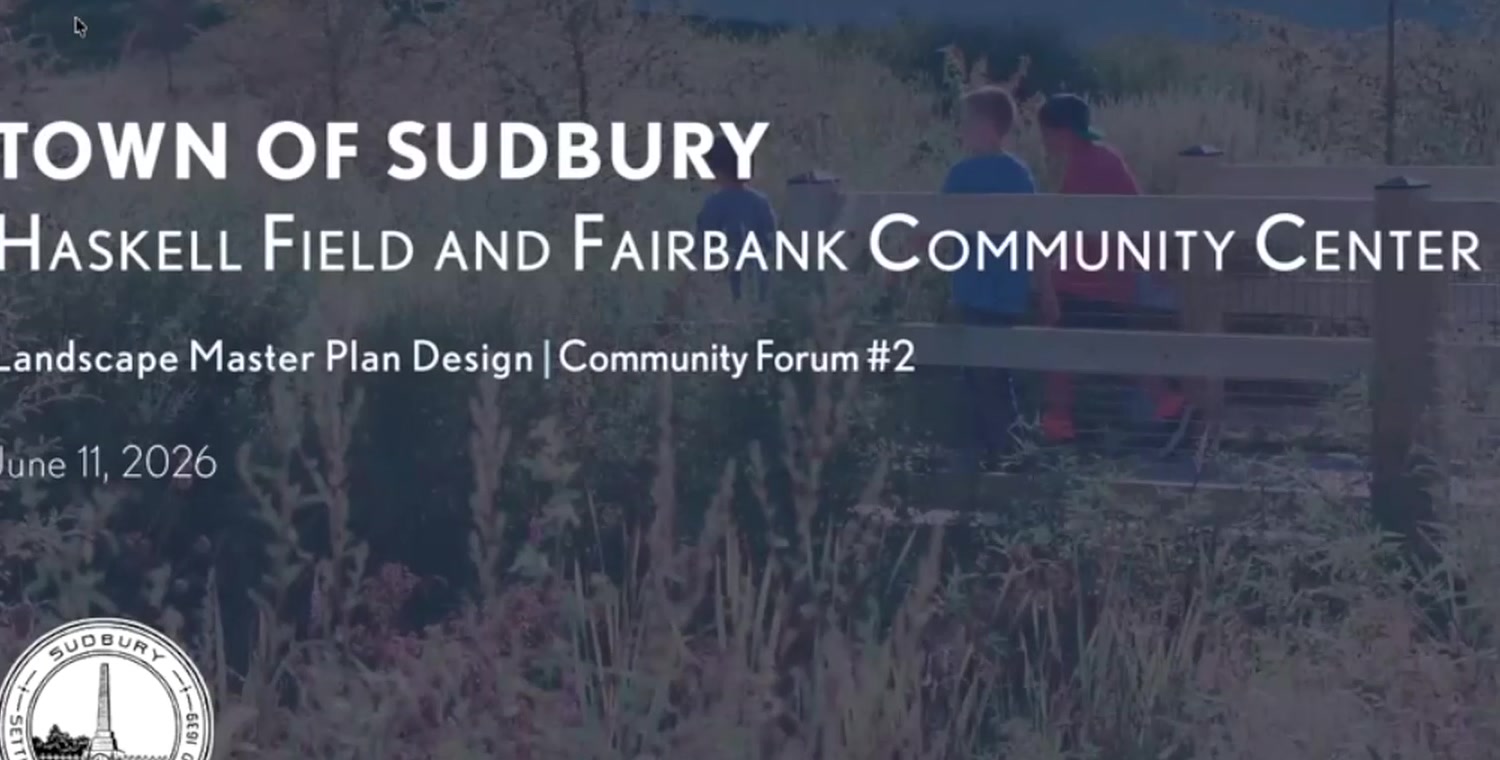
All of this sits inside a larger question – what Haskell and the Fairbank Community Center should become. On June 11, the town’s consultant, Activitas, presented revised concepts at the second of two community forums, stressing they are conceptual: “a living document” needing more design, permitting, and input before anything is built.

Accessibility drives the design. A main purpose is meeting the state accessibility code (521 CMR 19.00), which requires paved routes to public fields. The plan adds walkways six to ten feet wide, including one through the middle of the park – which the architect said cut a trip to the back field from about eight minutes to four.

Turf or grass – still open. The concepts keep a synthetic turf field in play, in either the northeast corner near the parking lot (Option 1) or in lower Haskell where baseball is today (Option 2); the team leaned toward Option 2. The grass-versus-turf choice is unresolved: a parent pressed for turf, citing rain-shortened seasons, while turf remains the more contested – if cheaper to maintain – option.


Amenities, debated. A splash pad was floated near the playground (usable only about two and a half months a year), while a dog park was recommended against – public dog parks need about an acre, and only a quarter-acre is available. When the commission reviewed the plan on June 15, members were lukewarm: the splash pad “seems to add a lot of complexity” given septic limits, and the dog park “didn’t fit well.”

On the Fairbank side, the plan adds a second multi-sport court, a larger (~30-by-60-foot) pavilion, and two options for bocce courts behind the senior center – boxed in by the building’s septic leaching field.

What’s next
The Haskell parking-lot survey is expected in early August, with another solar update at the commission’s July meeting; Beagan said he intends to ask the state to take a fresh look. Whether the bathrooms – the one thing nearly everyone agrees on – get fixed first is, for now, an open question.
Sources
- Haskell Field & Fairbank Community Center Landscape Master Plan – Community Forum #2 (Activitas), June 11, 2026: SudburyTV recording.
- Sudbury Park & Recreation Commission, June 15, 2026: SudburyTV recording and meeting agenda (PDF).
- 2026 Annual Town Meeting Warrant, Article 34, “Authorization to Proceed with the Haskell Field Solar Canopy”: town warrant (PDF).
- Park & Recreation Commission membership (Town of Sudbury).
- Fairbank Community Center & Haskell Field Landscape Master Plan Design (Town of Sudbury Facilities).
- Article 97 of the Articles of Amendment, Massachusetts Constitution; Massachusetts Architectural Access Board, 521 CMR 19.00 (Recreational Facilities).
- Park & Recreation Commission votes on the Haskell solar canopy: November 17, 2025, and April 19, 2026 (commission meeting records).